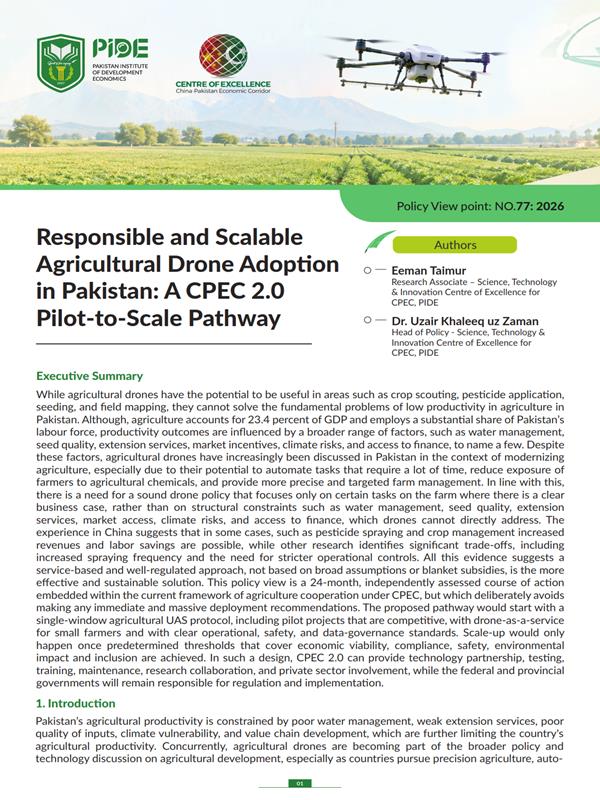
While agricultural drones have the potential to be useful in areas such as crop scouting, pesticide application, seeding, and field mapping, they cannot solve the fundamental problems of low productivity in agriculture in Pakistan. Although, agriculture accounts for 23.4 percent of GDP and employs a substantial share of Pakistan’s labour force, productivity outcomes are influenced by a broader range of factors, such as water management, seed quality, extension services, market incentives, climate risks, and access to finance, to name a few.
Despite these factors, agricultural drones have increasingly been discussed in Pakistan in the context of modernizing agriculture, especially due to their potential to automate tasks that require a lot of time, reduce exposure of farmers to agricultural chemicals, and provide more precise and targeted farm management. In line with this, there is a need for a sound drone policy that focuses only on certain tasks on the farm where there is a clear business case, rather than on structural constraints such as water management, seed quality, extension services, market access, climate risks, and access to finance, which drones cannot directly address.